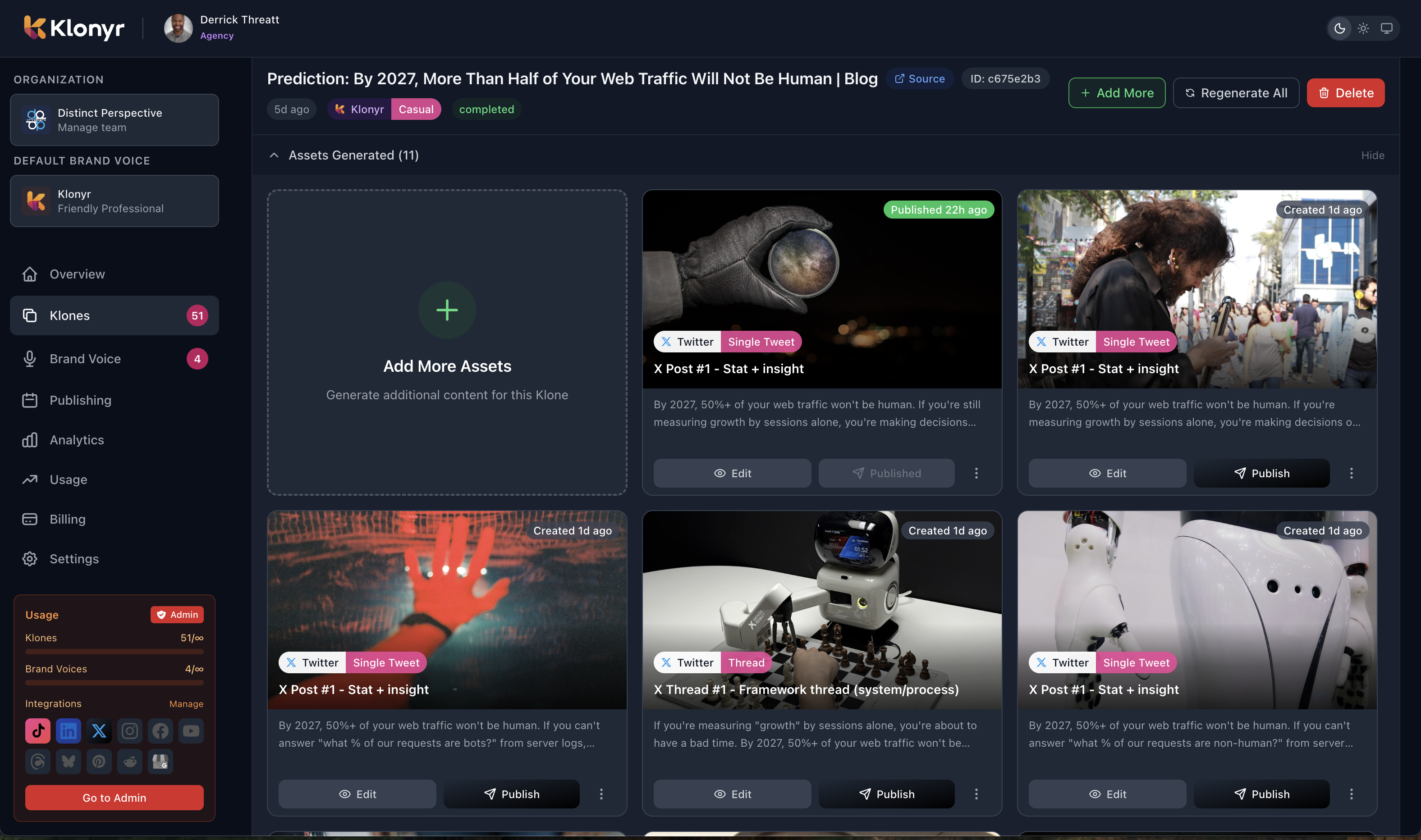
I bring people, knowledge, and technology together to make everyday work flow better.
WHAT I BRING TO YOUR TEAM
The vision to lead. The skills to build.
01
Lead the transformation.
I work with leaders and the people doing the work to find where AI can help, set priorities, and guide practical changes teams can adopt.
AI strategy · Innovation leadership · Workflow discovery
02
Engineer the solution.
I build the products, automations, and integrations that connect your systems. From the first prototype to the tools your team relies on every day.
AI engineering · Full-stack development · Systems integration
03
Make the experience matter.
My background in film, design, and marketing shapes interfaces that feel clear and memorable. I bring visual storytelling and technical execution to the same project.
Creative direction · Front-end experiences · Product design
HOW I WORK
Find the friction → Build the useful version → Prove it in the workflow → Keep making it better
BUILT AT SAFETYCHAIN
One company. A connected way of working.
At SafetyChain, I build the internal systems that connect what teams know to what they need to do next.
01Content + intelligence
ContentChain
+
A content engine and AI hub that checks claims, applies brand voice, tracks competitors, and connects company knowledge.
Publish with more confidence and give teams a shared source of intelligence.
02Account research
Benriched
+
Company research that builds an account profile from a website, evaluates fit, and includes confidence ratings.
Give sales a more useful starting point before the first conversation.
03Sales enablement
KeyChain
+
Deal history and customer calls become impact statements, proposals, handoffs, deal reviews, and presentation decks.
Help reps spend less time reconstructing a deal and more time moving it forward.
04Knowledge retrieval
Support AI
+
A support assistant in the browser and Slack that retrieves company knowledge, cites its sources, and separates internal context from customer answers.
Make hard-won expertise easier for every support rep to use.
05Web platform
safetychain.com
+
Ownership of the website program: architecture, continuous releases, publishing workflows, and the contract developers delivering the work.
Let marketing move while keeping engineering quality and brand consistency.
06Design systems
Styles
+
Shared colors, typography, components, messaging, and brand knowledge used across digital and physical touchpoints.
Make consistency part of the system instead of another review cycle.
07Event operations
ChainReaction
+
The Summit platform connecting ticketing, registration, sessions, badge check-in, and verifiable completion certificates.
Bring an entire event journey into one operating system.
08Mobile product
The Line
+
The Summit’s iPhone and Android app: agendas, networking, questions, ratings, and notifications, synchronized with the event website.
Put a connected event experience in every attendee’s pocket.
My role spans building directly, defining the architecture, and scoping and leading contract developers on larger initiatives.
INDEPENDENT PRODUCTS
Built from a problem. Made to be useful.
Four products. Four different workflows. The same instinct to make things work better.
01 / INDEPENDENT PRODUCTDESIGNED & BUILT BY DERRICK THREATT
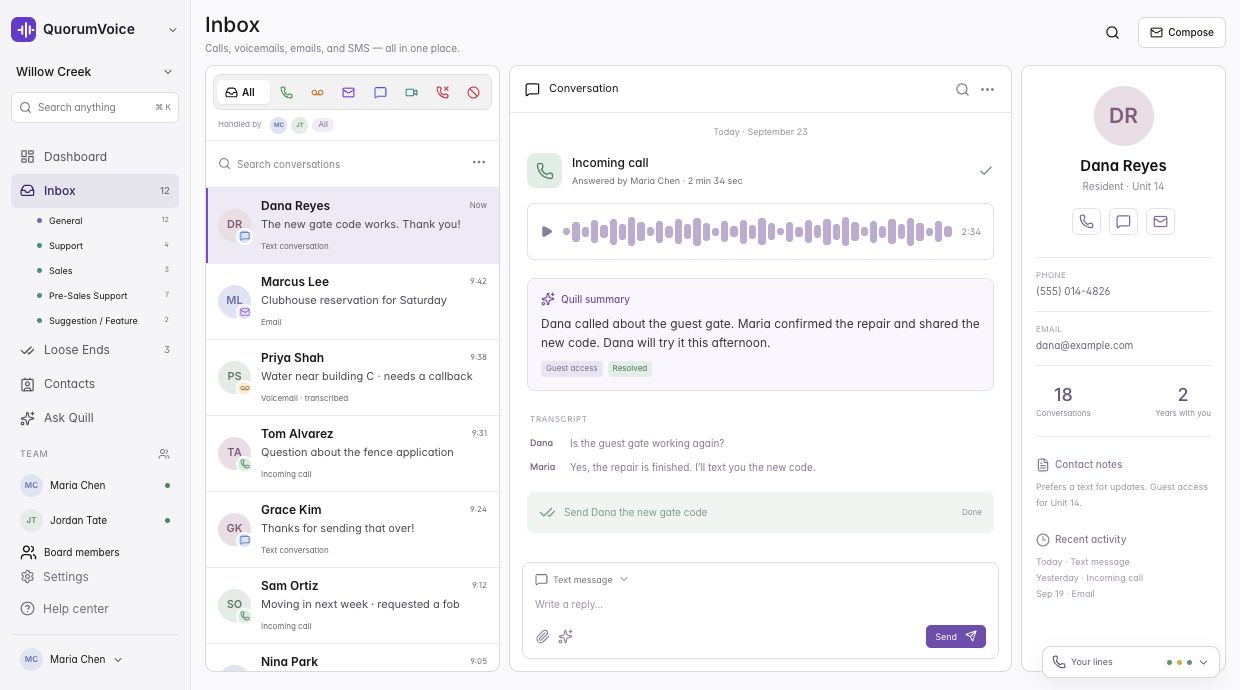
A call is never just a call.
Voice, context, knowledge, routing. I build the connections that turn a conversation into useful work.
FROM THE FIRST CONVERSATION TO THE WORKING PRODUCT
Good ideas need someone who can build them.
QuorumVoice brings together the work I care about: connected systems, useful AI, and an interface that makes the complexity feel simple.
That’s what I bring to your organization—from finding the right problem to designing, building and improving the solution.
I’ve produced and shot music videos, commercials, and event films—and handled editing, compositing, motion graphics, and aerial cinematography. That work taught me how to guide attention through composition, light, pacing, and movement.
I bring that same eye to the front end: purposeful animation, cinematic transitions, and interfaces with a wow factor. Paired with my engineering and AI automation background, I can design the experience and build the systems that make it useful.
Ask a new question about intelligence: could a machine hold a conversation indistinguishable from a person’s?
KEY PLAYERS
Alan Turing
The story behind it
In Computing Machinery and Intelligence, Turing proposed the imitation game as a way to explore machine intelligence. It was a conceptual test, decades before conversational AI became an everyday tool.
Imagine machines that learn, reason, and solve problems. The research field begins to take shape.
KEY PLAYERS
Dartmouth
Research community
The story behind it
The Dartmouth summer research project helped establish artificial intelligence as a field. This was the beginning of a research agenda; practical AI tools were still far away.
Train a simple artificial neuron to classify patterns, laying early groundwork for neural networks.
KEY PLAYERS
Frank Rosenblatt
Cornell Aeronautical Laboratory
The story behind it
Rosenblatt’s perceptron research explored learning through adjustable connections. Its capabilities were limited, but the idea of learning weights from examples helped shape the history of machine learning.
Search enormous numbers of possibilities and compete at the highest level in a tightly defined task.
KEY PLAYERS
IBM
The story behind it
IBM’s Deep Blue defeated reigning world chess champion Garry Kasparov in a six-game match. Specialized hardware, search, and chess evaluation powered the achievement; it was not a general-purpose assistant.
Classify images with a major jump in accuracy, advancing the foundations for visual search and inspection.
KEY PLAYERS
University of Toronto
The story behind it
AlexNet demonstrated the effectiveness of deep convolutional networks trained on GPUs in the ImageNet competition. University research helped establish the approach behind a new wave of computer vision.
Combine learned patterns, search, and self-play to navigate a game with extraordinary complexity.
KEY PLAYERS
Google DeepMind
The story behind it
AlphaGo defeated Lee Sedol four games to one. DeepMind combined neural networks with search and reinforcement learning, demonstrating progress in strategic decision-making within a specialized research system.
Process relationships across a sequence more efficiently—a foundation for the language models that follow.
KEY PLAYERS
Google Research
The story behind it
“Attention Is All You Need” introduced the Transformer architecture. Google researchers demonstrated strong translation results using attention rather than recurrent or convolutional layers.
Build text generation, classification, and summarization into products using prompts and examples.
KEY PLAYERS
OpenAI
The story behind it
OpenAI began offering developers access to a general-purpose text-in, text-out API. The GPT-3 era made it practical to experiment with many language tasks through the same interface, initially with limited access.
Suggest lines of code and entire functions in the context of what a developer is building.
KEY PLAYERS
OpenAI
GitHub / Microsoft
The story behind it
GitHub launched Copilot in technical preview, powered by OpenAI Codex. OpenAI supplied the model while GitHub brought the experience directly into developers’ daily workflow.
Generate visual concepts from a description and adapt downloadable models for new creative tools.
KEY PLAYERS
Stability AI
LMU Munich
Runway
The story behind it
Stable Diffusion’s public release expanded access to text-to-image generation. Stability AI, researchers at LMU Munich, and Runway helped bring the technology to creators and developers under its model license.
Draft, brainstorm, explain, and troubleshoot through ordinary language and follow-up questions.
KEY PLAYERS
OpenAI
The story behind it
ChatGPT launched as a free research preview on November 30. OpenAI packaged its language-model capabilities into a conversational interface that people could use without writing code.
Handle more demanding writing, coding, and analysis with stronger instruction following and human review.
KEY PLAYERS
OpenAI
The story behind it
GPT-4 advanced reasoning and instruction following over the earlier ChatGPT experience. OpenAI made it available through ChatGPT Plus and began rolling out API access; image-input access was initially limited.
Adapt and host a capable language model yourself, with more control over deployment and customization.
KEY PLAYERS
Meta
Microsoft
The story behind it
Meta released Llama 2 with downloadable weights and a license permitting research and commercial use subject to its terms. Microsoft was its preferred launch partner, supporting a growing alternative to hosted-only models.
Work across much larger documents, codebases, audio, and video in a single context.
KEY PLAYERS
Google
The story behind it
Google introduced Gemini 1.5 Pro with a million-token context window in limited preview. Long-context processing became a central part of Google’s approach to multimodal AI.
Interact more naturally across text, images, and audio, with faster conversational responses.
KEY PLAYERS
OpenAI
The story behind it
OpenAI demonstrated a unified multimodal model designed for real-time interaction. Text and image capabilities arrived first, with the new audio experience and other capabilities rolling out in stages.
Use additional thinking time to improve results on difficult coding, math, and science tasks.
KEY PLAYERS
OpenAI
The story behind it
OpenAI introduced a reasoning-model family trained to refine its approach before answering. These models complemented faster general-purpose models, introducing a clearer trade-off between response speed and reasoning effort.
Read a screen, move a cursor, click buttons, and type through a developer-controlled computer environment.
KEY PLAYERS
Anthropic
The story behind it
Anthropic introduced computer use in public beta. It opened a path to interacting with software through its interface, though the early capability remained experimental and required appropriate setup and supervision.
Download reasoning models and smaller distilled versions for more flexible experimentation and deployment.
KEY PLAYERS
DeepSeek
The story behind it
DeepSeek became a prominent reasoning-model challenger with R1 and its distilled models. Available weights gave developers additional options for adapting and running reasoning systems.
Let coding agents explore repositories, fix bugs, use tools, and prepare changes for review.
KEY PLAYERS
OpenAI
Anthropic
The story behind it
OpenAI launched its cloud-based Codex agent in research preview. In the same month, Anthropic introduced Claude Opus 4 and Sonnet 4, emphasizing coding, tool use, and longer agent workflows.
Sustain longer, more complex coding and professional assignments, including asynchronous work spanning days.
KEY PLAYERS
Anthropic
The story behind it
Anthropic introduced Fable 5 on June 9 as its fifth-generation flagship for demanding work. Access was temporarily suspended on June 12 and restored on July 1. Its emphasis was sustained execution on longer, harder tasks.
Advance coding, knowledge work, and research with lower costs for workflows that reuse context.
KEY PLAYERS
Anthropic
The story behind it
Fable 5.1 advanced Anthropic’s generally available frontier model. Its counterpart, Mythos 5.1, shared the underlying model with different safeguards and restricted access. Reduced cache-read pricing lowered costs for repeated context.
Combine research, software interaction, coding, and document creation across multistep professional tasks.
KEY PLAYERS
OpenAI
The story behind it
OpenAI introduced GPT-6 Astra with an emphasis on computer use and professional work. These capabilities expand what teams can delegate, while workflow design, permissions, and review still determine how useful the result is.












 DESIGNED & BUILT BY DERRICK THREATT